How Native Americans Used A Ball Game To Infiltrate A Fort
As someone who didn’t grow up in the United States of America, the game of Lacrosse didn’t really feature on my radar until I stumbled upon it one day while watching ESPN. It was a confusing experience for me, to say the least, as it looked like ice hockey players had taken off their skates while at the same time my tv’s refresh rate wasn’t quite good enough to keep up with how fast the ball was moving, so I just couldn’t work out what was going on at all.
Needless to say, in my youthful ignorance I assumed from the name that it was a French sport imported to the Americas, but when coming across this story I was fascinated to learn it’s true origin story and how it was once even used by a tribe of Native Americans as a ruse to help them infiltrate a British fort.
Lacrosse wasn’t always called Lacrosse. In fact, when it was first invented, somewhere around 1100AD, the North American tribes who began playing it called it “Baggatiway”.
It was only in the 17th century however, when it’s name was changed to Lacrosse by a Jesuit missionary named Jean de Brebeuf.
As a side note, the story of this missionaries life is fascinating in it’s own right, not to mention his truly gruesome end. There have been hundreds of thousands of martyrs throughout the ages, and yet the method of torture that this poor man was put through before finally being killed is still held up as quite possibly one of the worst of them all. In fact, it’s so graphic that i’ve chosen to just leave it there and rather keep going with the story.
Now lacrosse, for those like teenage me who may have never seen it played looks, in appearance rather similar to ice hockey. Big pads, big goalie, small goals and a stick in each players hands. But on the end of each of these stick is a smaller, shallower version of a kids fishing net, and the small rubber squash ball lookalike is flung between players, caught in their fishing nets and then somehow thrown at such high speeds through the tiniest of gaps between the goalkeepers enormous padding and the frame of the very little goals.
Americans, or in fact actual lacrosse players, please let me know if I did a good job painting a picture of that for everyone.
Now needless to say, that is the modern version of the sport, but when it first began it’s proportions were unbelievably different. The original game was played on an open flat piece of land anywhere from 500m to 3km long and instead of precisely timed halves or quarters, the game could last from sunrise to sunset, and in some instances even lasted up to 3 full days. Each team consisted of anywhere between 100 and 1000 players each, and despite it being a fun exercise, it’s original intended purpose was a ceremonial ritual preparing young men for war.
Now lets fast forward to the early 1700’s and we find ourselves outside a fort named Michilimackinac, which let me tell you is not at all pronounced how it’s spelt.
At this point in time the fort has around 30-40 soldiers stationed within it, but is being used as much as a trading post for local fur trappers as it was for anything else. The traders would come from as far away as Montreal to trade with the hundreds of Native Americans who lived in the surrounding area.
The wooden fort had originally been built by the French in 1713 as they established a presence along the Mackinac Straits. Over the years the fort grew in size as expansions and modifications were made to the structure along with the construction of new palisade walls. The French soldiers stationed there had ingratiated themselves with the local tribes in the area and while they may not have been best buddies, the relationship was certainly cordial between them.
In 1756 however war broke out between the French and the British in what was globally known as the Seven Years War. The clash had emanated over a dispute concerning territorial rights to colonies in North America and India, and so it was surely only a matter of time until that conflict found it’s way to the top of the Michigan mitten. Owing to their good standing with the local peoples the French enlisted the help of the Native American warriors who combined forces against the British and American troops.
By the time 1761 rolled around the French had been soundly beaten by the British forces and so reluctantly abandoned their fort. A short while later it was taken over by the British who moved in and were eager to stamp their authority on the region.
But their presence was not entirely welcome. Most of the inhabitants of the town around them were still either French settlers or a part of a mixed race group known as the Métis who were the product of years of intermarriage between the French settlers and the local Ojibwe tribe. Not to mention the fact that for years the British had actively been killing many of the relatives of the people who were left behind once the war was finally over.
The British, however, tried to maintain a certain level of the status quo, opening the fort to fur traders and others but failed in their upkeep of one particularly important tradition.
Besides their stricter policies and their eagerness to enforce them, they cancelled a long standing tradition, that the French had originally instituted, whereby once a year they distributed lavish gifts to the surrounding Native American tribes.
When this was coupled with a British campaign of postwar policies specifically targeting the rights and freedoms of the Native Americans, the breaking point had finally been reached.
A number of prominent leaders, most notably among them Pontiac, the war chief of the Ottawa tribe, decided that enough was enough and it was time to fight back.
Over the next year or so, they managed to capture 4 small forts before attempting to attack Fort Detroit which ultimately ended in a stalemate.
It was not long before Fort Michilimackinac became their next target.
We’re going to take a short break, and when we come back we’ll explore in detail just how the local Ojibwe and Sauk tribes fooled the unsuspecting British troops.
It’s unclear to me why the British troops weren’t on higher alert. They surely must have known that their forts were continuously coming under attack in other parts of the Great Lakes region. Perhaps they suffered from that age old mental trick we play on ourselves, thinking that it could never happen to them.
It’s also unclear to me why the local tribes warriors chose the route of deception on this particular occasion, but for the sake of this story, I’m very glad they did. Perhaps it was because they had staged similar games outside the fort before and on all of these occasions had seen how the entire army garrison came out to relax beside the field and watch.
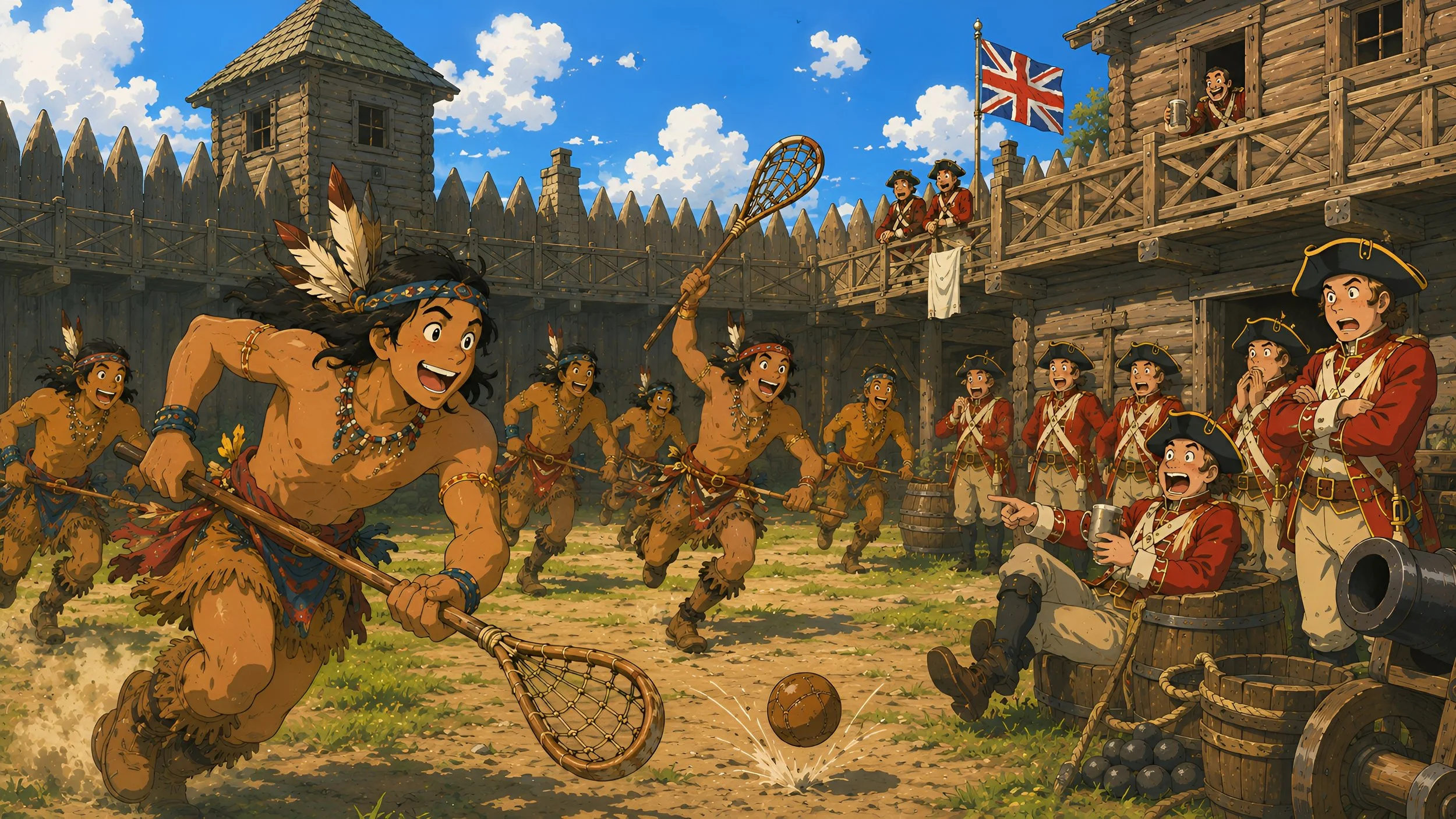
Whatever their reason as the sun rose on the morning of June the 2nd, 1763, one of the Ojibwe leaders informed the British soldiers that once again they would be staging one of their Baggatiway games outside if any of them would like to come and watch.
Now it was an unusually hot day, even for late Spring on the Straits of Mackinac and the British Major George Etherington could think of nothing better to while away the time, than sitting in the shade of the palisade walls and watching a rousing ball game.
He was just 30 years old at the time and had in fact been born in the colonies. He should have been no stranger to Native American warfare tactics and had fought against them himself at the very end of the Seven Years War.
It didn’t seem to worry him that he and his men numbered just 35 soldiers while there seemed to be a significantly higher number of the local tribespeople there to watch than usual.
It also didn’t seem to click in his mind that a lot more knives and tomahawks had been bought recently from inside the garrisons trading post.
Sure, he’d been warned of course that he should be on the lookout for any signs of rebellion amongst the locals, but it was hot and he just wanted to relax for a bit.
Even when the renowned fur trader Charles Langlade, one of the mixed race members of the local population warned him to rather be safe than sorry, Etherington simply told him to stop worrying and go trap some beavers. This was a very silly thing to do for two reasons, the first was that Charles, having grown up alongside the Native American tribes since he was a boy and who was very highly respected by them, surely had some insider knowledge that something was brewing. But secondly, and most importantly, he had seen the kinds of terrible pain and suffering his cousins could inflict upon their enemies, as in the case of the aforementioned Jesuit priest.
But Etherington was seemingly willfully blind to it all, and when told that the game being played that day was in celebration of the British King’s birthday, well surely they wouldn’t lie about something like that, would they?
He gathered up his troops and they sauntered out of the gates of the fort and got comfortable on the soft green grass. In yet another crucial error, because the idea that they were in any kind of danger was just so far from their minds, they not only lef the gates of the fort wide open, but all of the soldiers had left their guns inside as well.
It wasn’t long before the game was in full swing, and rather sadly, Etherington was cheering wildly for the Ojibwe team as they took on their local rivals the Sawk.
In yet more examples of his utter obliviousness, he didn’t spot the fact that Charles Langlade had left the sidelines with his family and holed himself up tightly inside his house.
He also didn’t seem to notice that there was a disproportionate amount of Native American women casually congregating near the open gates of the fort. And what was even stranger was that for some reason, they were all covered in heavy, floor length blankets wrapped tightly around their shoulders as if the blazing sun above them was nothing more than a dying ember.
The game that day had more than 500 players spread across both teams, and more so than usual their ceremonial war paint and charcoal seemed brighter and more carefully applied.
Etherington watched on curiously as the ball was lofted high into the air and after a seemingly misplaced throw, landed right between the open gates of the fort. A large group of players followed the ball as if to retrieve it when all of a sudden the feeling in the air changed abruptly.
As the group of men charged to retreive the ball, the swathes of Native American women who were now standing right alongside them, suddenly threw off their heavy blankets to reveal knives, tomahawks and an assortment of other bladed weapons all strapped to their bodies. They were quickly handed to the crowd of men and within seconds the sound of anguished screams began to fill the air.
Major Etherington, and his Lieutenant William Leslye, saw what was unfolding and quickly dashed into the nearby woods. The only other officer the fort had was Lieutenant Jamet and despite being possibly the only man that day who had kept his weapon with him, it mattered very little as he was quickly cut down.
A young English fur trader named Alexander Henry managed to barricade himself inside his dwelling. He later wrote in excruciating detail the events that followed that day.
“Going to my window, I saw a crowd of warriors within the fort, furiously cutting down every Englishman they found.”
He noted with that it seemed the Native American warriors were specifically targeting the British inhabitants of the fort and were very clearly sparing the French Canadians. Knowing that if they found him, his time on this earth would be short, he made a break for his neighbours house, who just happened to be Charles Langlade. He begged Charles to help him, but Charles, himself less than enamored with the British simply replied in French “What do you want me to do about it?”
Henry, on the verge of full blown panic by now, was overwhelmed with relief when one of Langlades servant girls pushed him up a ladder and hid him in the attic. Just next to his head in the cramped crawlspace was knot in the wooden board through which he could observe the massacre below.
It would not take long however before he was discovered and he, along with a few other fellow prisoners, were paddled to the nearby Beaver island with no food or shelter. The Ojibwe warriors took some bread and held it in front of the cowering men. One of the men produced his knife, still stained with the blood of the English lives he’d taken and slowly cut a slice from the loaf. Before handing it over he spat on the bread and smeared it into the streaks of blood that now stained it’s outer edge. Henry refused to eat it, and so he and the other captives were loaded once again aboard the canoe as they were paddle back out into open water; The next few days would prove to a truly bizarre series of fortunate events in the life of Alexander Henry.
First, as the canoe paddled out from Beaver island, a thick fog rolled in across the water forcing the Ojibwe warriors to dock their canoes at a nearby Ottawa encampment. When the Ottawa chief discovered that they had not been invited to participate in the massacre, he flew into a rage, seizing Henry and the other captives for himself before paddling them back to the fort, whereupon they themselve took control.
Leaders from both sides came together to hash things out, and later that day Henry and the others were handed back to the Ojibwe.
And here is where it gets truly wild. As the captives were paraded before the chief, who had already decreed that all of the men should be put to death, a young Ojibwe warrior by the name of Wawatam stepped forward. One year before he had received a vision from the Great Spirit that he should adopt an Englishman as his brother. The vision had shown him one man in particular, a man he had never seen before, but in that moment he had sworn an oath to do what the Great Spirit instructed him.
Now, as the men were filed past him, he recognised for the first time, the man he had been shown in his vision. The man was none other than Alexander Henry. Wawatam convinced the chief to spare him, and promised to take care of him himself.
In utter disbelief, Henry was escorted back to Wawatams lodge where that night he fell into an exhausted slumber. As he awoke the next day and stepped outside into the early morning sunlight, he was horrified to see that right there in front of him were the bodies of the other captives who had arrived with him just the day before.
As for Major Etherington and his Lieutenant, they too were eventually captured, but owing to their rank and status were far more valuable as ransoms, which were eventually paid by a Commandant James Gorrell from the nearby fort in Green Bay, Wisconsin.
The Michilimackinac fort was soon abandoned by the warriors and the only people left inside were a handful of local French traders. With no formal leadership to speak of, it soon fell to Charles Langlade to assume the governance of the fort.
The entire saga of the attack on Fort Michilimackinac was a small part of a much larger and grander story playing out across the whole of North America at the time. It does however, stand as a stark reminder that battles aren’t always won with sieges or full frontal assaults, sometimes, they’re won with patience, cunning, and a small wooden ball.
SOURCES
MyNorth. "Deadly Lacrosse Game in Mackinac Straits at Fort Michilimackinac in 1763." MyNorth, May 2014. https://mynorth.com/2014/05/deadly-lacrosse-game-in-mackinac-straits-at-fort-michilimackinac-in-1763/.
The Art of Lax. "Fort Michilimackinac." The Art of Lax. https://www.theartoflax.com/fortmichilimackinac/.
NLL Chatter. "The Deadliest Lacrosse Game Ever." NLL Chatter, August 10, 2015. https://nllchatter.com/2015/08/10/the-deadliest-lacrosse-game-ever/.
Canadian History Bits. "Lacrosse Massacre – Fort Michilimackinac." Canadian History Bits, June 16, 2015. https://cdnhistorybits.wordpress.com/2015/06/16/lacrosse-massacre-fort-michilimackinac/.
Wikipedia. "Fort Michilimackinac." Wikipedia: The Free Encyclopedia. Last modified [date unavailable]. https://en.wikipedia.org/wiki/Fort_Michilimackinac.