The Candy Bomber of Berlin
War is, as has been well documented, about as close to hell on earth as one can get. Yet out of these terrible conflicts, there are always glimmers of humanity that shine through in even the darkest of moments. In times of difficulty, turmoil and loss, we look for goodness, hope and joy. And sometimes we find them in ways we never expect, in a friendly word or even in a small act of kindness.
And so today we get to look back on the story of a man who used what little he had to be a light in the darkness and brighten up the days of grateful children caught in a conflict not of their own making.
This is the story of Gail Halvorsen, who was known to the children of Berlin as Der Schokoladen Flieger or The chocolate flier, Uncle Wiggly Wings or the most widely known of all, The Candy Bomber of Berlin.
Gail Seymour Halvorsen was born in Salt Lake City on October 10, 1920, to Basil and Luella Halvorsen. He grew up on small farms first in Idaho and then in Utah. He attended Utah State University and while there earned his private pilots license under the non-college Civilian Pilot Training Program in September 1941. Once he had his license he soon joined the Civil Air Patrol as a pilot. Only a few months later Halvorsen decided to join the United States Army Air Forces in May of 1942 and was just 22 years old when he arrived in Oklahoma begin his training. He was assigned to a squadron to train with 25 aviation cadets, and 77 Royal Air Force cadets, at the No. 3 British Flying Training School. After completing his pilots training, he returned to the Army Air Forces and was assigned flight duties in foreign transport operations in the South Atlantic. Once the 2nd world war was over and the cold war had begun to set in, he was ordered to report to Germany on July 10th of 1948, to be a pilot for what is now known as the Berlin Airlift.
At the end of the war Germany had been divided into four seperate and distinct zones of occupation. Each of America, Britain, France and Soviet Russia laid claim to a quarter of the country. In yet more unnecessary confusion, the bombed out capital of Berlin, which fell entirely within the Soviet controlled section, was itself further divided by the 4 nations with the Soviets claiming control of the entire Eastern half of the city. As the cold war began and the other 3 nations combined their territories into one single functioning economic zone, the soviets began to fear that Western forces would try a takeover of their East Berlin territory. So in 1948 they began blockading and eliminating all access routes via rail, road and canal into the Allied controlled Western half of the city. A potentially unintended consequence of this action, or if intended makes it crueler than necessary, was that the population in that half of the city now had no means by which to bring in medicine, fuel, coal for heat and electricity or even fresh food. 2.5 million people slowly began to run out of these essential items and their prospects for the future were looking grimmer with each passing day. But all was not lost for them as there was one route into Berlin which had not been closed off, and that was the sky above them.
In fact, back in 1945 as the war ended and the country was being divided up, no plans had been made with regards to safe passage along ground routes from the Allied occupied territory in West Germany to their enclaves in West Berlin. This was not the case however when it came to agreements with regards to aerial routes. It was on the 30th of November 1945 that they had agreed that there would be three 20 mile wide air corridors through which the other 3 nations could freely access Berlin. This was agreed ostensibly to fly in any sort of aid packages to their territories, and unlike tanks, trucks and other armaments, the Soviets couldn’t claim to feel threatened by simple cargo aircraft ferrying goods back and forth.
It was because of this pre-agreed concession, that the idea of the Berlin Airlift was first brought to the table. The allied forces couldn’t sit back and watch their troops and the people in their territories starve or freeze to death and so swiftly began planning a way to get supplies into the territory.
The British had themselves even begun a smaller more targeted airlift of their own to support just the British troops in Berlin and so when the American forces came calling with a request to work together in a joint airlift operation, the British could bring concrete numbers to the table when it came to the amount of resources that would be required to support the entire city.
It was calculated that for each adult they would need to provide a daily ration of just under 2000 calories worth of food. And when that number was timesed by the population in the city it came out a staggering figure. Each day they would need to fly in 646 tonnes of flour and wheat, 125 tons of cereal, 64 tons of fat, 109 tons of meat and fish, 180 tons of potatoes, 180 tons of sugar, 11 tons of coffee, 19 tons of powdered milk, 5 tons of fresh whole milk for consumption by the young children, 3 tons of yeast for baking, 144 tons of dehydrated vegetables, 38 tons of salt and 10 tons of cheese. That is a frankly ridiculous amount of food, and bear in mind that only lasted for one day. All in all, when calculated all together, that amounts to over 1 and a half thousand tons of supplies each and every day to sustain the over 2 million people. And yet even this paled in comparison to the 3 and half thousand tons of coal, diesel and petrol required for daily heating, electricity and fuel.
Initially one might think the problem would be sourcing all of those goods, but in fact the bigger logistical issue was how to transport roughly 5000 tons a day when at that point they only had enough aircraft to transport around 700 tons a day if all went smoothly. The United States, Britain and Australia joined forces to make this airlift supply to Berlin a reality. It took some time to put all of the logistical plans in place but soon hundreds of planes were being flown in to aid the effort at hand.
As day one of the airlift began and the myriad of moving parts all began to align themselves they were only able to send just 90 tons of supplies. By week two however they were up to 1000 tons a day and becoming more and more efficient with each round trip. More than 1000 aircrafts were involved in the supply chain back and forth and so some very efficient planning was needed in order to make sure they could all safely fly there and back without crashing into one another. They came up with an amazing strategy. Due to there being 3 corridors within which they could safely fly, they would all set out Northeast through the American corridor, landing at Tempelhof Airport, then having offloaded their cargoes they would return due West via the British Air Corridor. Once they safely reached British air space, they would return to their respective bases for restocking.
Many aircraft didn’t even waste time with landing and would simply parachute their coal supplies directly onto the airfields and return home again. Some specialised water planes were even brought in that could land on the Havel river and due to their corrosion resistant hulls they were the perfect vessels to deliver baking powder and salt into the city.
The next problem they faced was that they had aircraft taking off every 4 minutes and due to the narrow airspace they began having to essentially stack the aircraft in the sky so as to ensure their safety. Each plane that took off would fly 1000 feet higher than the flight in front of it beginning at 5000 feet and then repeating five times before starting again from the bottom. This system would later come to be known as the ladder.
Gail Halvorsen reported for duty in July 1948. He had remained in military service even after the war as he had hoped at some point to see combat. Even though he had served in World War 2 he was assigned the task of ferrying bombers and transport planes across the South Atlantic Ocean for the European and North African campaigns, all of which turned out to be combat free missions. When the war was over he was sent to a base in Alabama and when the military began looking for willing and able pilots to support the Berlin Airlift mission, Halvorsen was eager and willing to help.
He began his supply runs with the other pilots and was drawn in by the beauty of a country dragging itself out of a devastating war. He was so enamoured by Berlin itself in fact that even on his own personal off time, he chose to tag along on a flight into Berlin so that he could make short mini movies with his personal hand-held camera. It was this act in particular that would change the course of his life, and the sentiment behind the airlift in general, forever.
We’re going to take a short break, but when we return, we’re going to see how one man’s compassion would forever leave an indelible mark of kindness on the lives of thousands of German children.
It was on 17th of July 1948, just a month into his new role, that he touched down at Tempelhof airfield and seeing a crowd of children gathered at the end of the runway, walked over to them to see what they were up to. When he reached them, he introduced himself in his best broken German and they began asking him all sorts of questions about the aircraft and their flights in and out of the city. He spoke to them for a while, as best he could, and then just before heading back to the plan he felt around in his pocket for something to give to the children as a parting gift. All he had was two sticks of Wrigleys Doublemint Chewing Gum. The childrens eyes widened and the boy who received the gum from him quickly set about dividing it up equally amongst all the children who were present, even passing the gum wrapper around for other children to smell. None of the children fought over the gum and were overjoyed to taste even just the tiniest of slivers. Halvorsen was so impressed by their manners and gratitude that he promised the children that the next time he flew over the city he would drop off some more sweets for them. As he was leaving, one of the children said, there are so many aeroplanes flying over head each day, how will we know which one of them is you? He simply replied, “Don’t worry, I’ll wiggle my wings.”
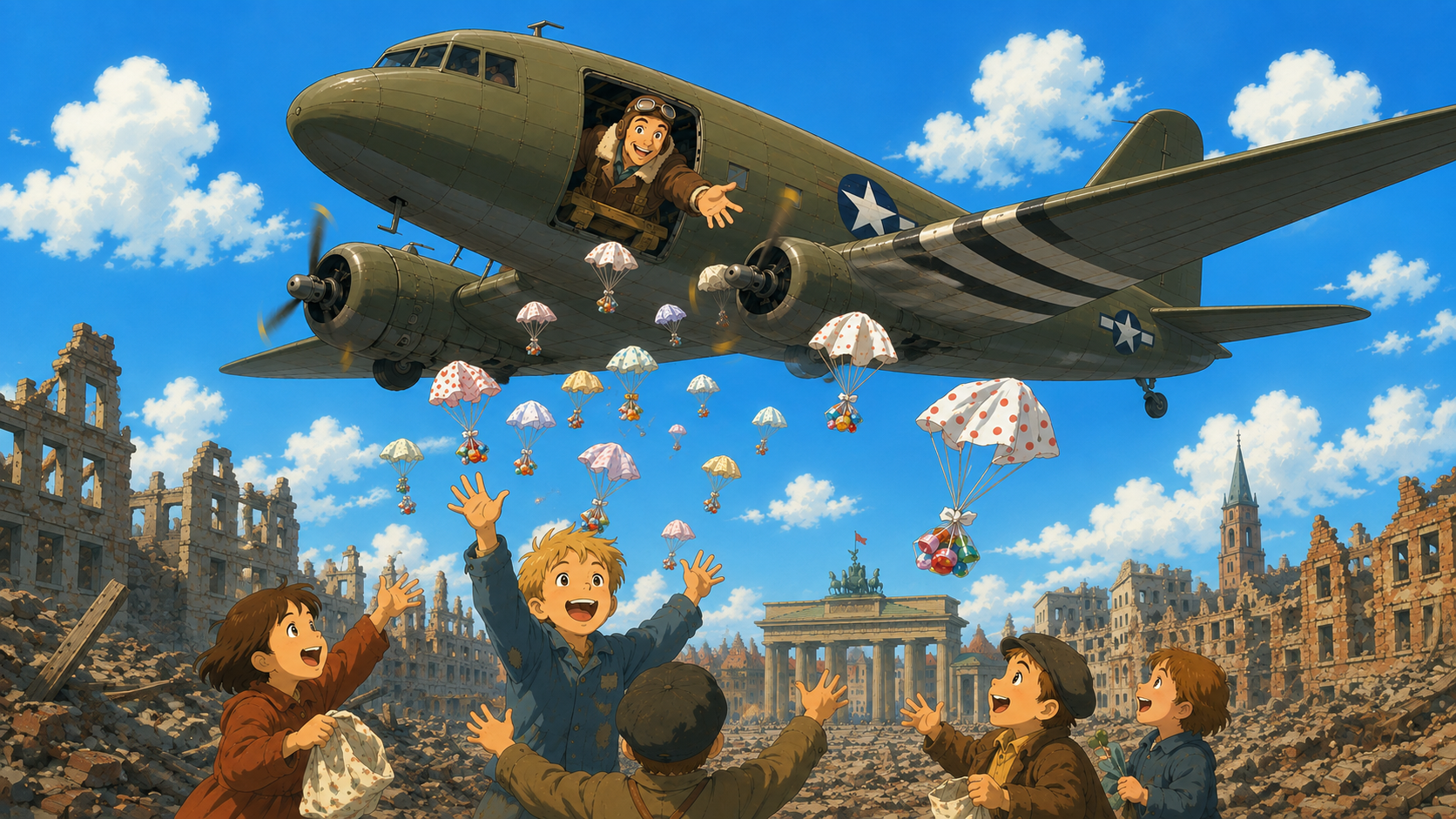
Morning dawned the following day and lieutenant Halvorsen remembered his promise to the children at the airfield. He told his copilot and engineer of his plan and together the three men pooled their candy rations for the upcoming drop. Halvorsen began packaging up the candy stash into three separate packages and, realising that the bundles were quite solid and heavy, he made three little parachutes out of handkerchiefs which he attached to each bundle to make sure the falling candy didn’t hurt any of the children.
They loaded up the plane with the cargo for the drop and Halvorsen made sure to keep the three little packages with him on his lap. Once everything was ready and they were given the green light to take off Halvorsen lifted his craft into the sky and turned towards Berlin.
After a while he could see the city in front of him and began his approach toward Tempelhof airfield. As he drew closer he began to notice a small crowd of children gathered just outside the airfield gates. They had been waiting for him to arrive. He put his hand on the controls and as he neared them he shifted it left and right wiggling the aircrafts wings to signal his arrival to the children. He slid open his window and dropped the packages to the jubilant children eagerly waiting below.
Naturally word got around the base of what he and his team were doing and soon pilots, engineers and other air service men were donating their candy rations to Halvorsen to drop on his missions into the city. Each and every day that Halvorsen flew into the city the number of children waiting below grew and grew.
Eventually it got to the point where Halvorsen had too much to carry in one trip and so he enlisted the help of other pilots to drop the candy as well. They agreed and all would go through the same ritual of wiggling their wings and dropping the parachute packages out of the window to the children below.
Before long the airbase became inundated with letters from children with special requests for certain types of candy, and even more just wanting to say thank you to the pilots for the treats they dropped each day. An especially amusing letter arrived one day from a 9 year old boy named Peter Zimmerman. In the letter he had included a homemade parachute and a map to his own house so that Uncle Wiggly Wings could make a special delivery directly to him. Halvorsen was enamoured with the letter and so on his next flight, tried his best to follow the directions given to him by young Peter, but to no avail. It wasn’t 3 days later that another letter arrived from young Peter Zimmerman which simply read: “No chocolate yet. I thought you were a pilot, I even gave you a map. How did you guys win the way anyway?”
Halvorsen, instead of being offended by this letter took it in good spirits and to make sure that the audacious Peter Zimmerman received his share, mailed a chocolate to his home address.
As word of Halversons candy bombs spread, his superior officers realised the potential for some good PR from all of it and in January of 1949 they flew him home to do somewhat of a press tour. The news had spread across the United States and supporters across the country were eager to help in any way they could. Two notable interactions he had while back home was meeting a housebound woman named Dorthy Groeger who, inspired by his actions, had enlisted the help of her network of friends to sew thousands of tiny parachutes for the candy bombers to attach the packages. In an even more impressive display was the work of a group of schoolchildren from Massachusetts who, through their efforts, were able to prepare over 18 tons of candy, chocolates and chewing gum from all across the country and then had it shipped to the airbase in Germany. As word spread further, major candy companies like Hershey’s began to get involved and donated as much as they could towards the effort.
In the end the Berlin airlift was in effect for just under a year, ending in mid May of 1949. In his 6 months of flying, Lt. Halvorsen personally flew 126 missions into Berlin. Along with more than 20 other pilots and crew it is estimated that they dropped more than 250 000 packages for the children of Berlin. In total, for the airlift as a whole, allied pilots flew more than 278 000 flights into Berlin and carried with them 2.3 million tons of food, coal, medicine and other essential supplies.
The children of Berlin never forget about Uncle Wiggly Wings. In 2004 a woman named Ursula Yunger spoke about being a child in those days. She said: “Gail Halvorsen enchanted the children of Berlin. In truth, it wasn’t even about the candy, it was his profound gesture, showing us that somebody cared.”
Just a year before she gave this interview she had managed to meet Gail Halvorsen in person for the very first time. She recalls how nervous she was, but he walked into the room, hugged her and handed her a Hershey’s chocolate bar.
A woman named Christel Jonge Vos, who had been 11 when she had stood at that airfield fence wrote about how the daily ritual became a symbol of hope and fun at a time in which both were scarce.
Many years later the Mayor of Berlin would go on to say “Halvorsen deeply human act has never been forgotten.” And Halvorsen himself sums it all up rather nicely when he said that “The only way to fulfillment in life, real fulfillment, is to serve others.”
SOURCES
Smithsonian Magazine. "The Sweet Story of the Berlin Candy Bomber." Smithsonian Magazine, February 18, 2020. https://www.smithsonianmag.com/smart-news/sweet-story-berlin-candy-bomber-180965156/.
Hersheyland. "The Berlin Candy Bomber." Hersheyland. https://www.hersheyland.com/stories/the-berlin-candy-bomber.html.
Smithsonian Magazine. "Candy Bomber Who Airdropped Sweets to German Children in 1948 Dies at 101." Smithsonian Magazine, February 22, 2022. https://www.smithsonianmag.com/smart-news/candy-bomber-who-airdropped-sweets-to-german-children-in-1948-dies-at-101-180979610/.
Wikipedia. "Gail Halvorsen." Wikipedia: The Free Encyclopedia. Last modified February 17, 2022. https://en.wikipedia.org/wiki/Gail_Halvorsen.
Mashed. "The Candy Bomber of WWII Has Died at Age 101." Mashed, February 22, 2022. https://www.mashed.com/773855/the-candy-bomber-of-wwii-has-died-at-age-101/.
The New York Times. "Gail Halvorsen, Candy Bomber Who Airdropped Sweets to German Children, Dies at 101." The New York Times, February 17, 2022. https://www.nytimes.com/2022/02/17/us/gail-halvorsen-obituary.html.
Wikipedia. "Berlin Blockade." Wikipedia: The Free Encyclopedia. Last modified February 13, 2022. https://en.wikipedia.org/wiki/Berlin_Blockade#Start_of_the_Berlin_Airlift.
Encyclopaedia Britannica. "Berlin." Encyclopaedia Britannica. https://www.britannica.com/place/Berlin/Berlin-divided.